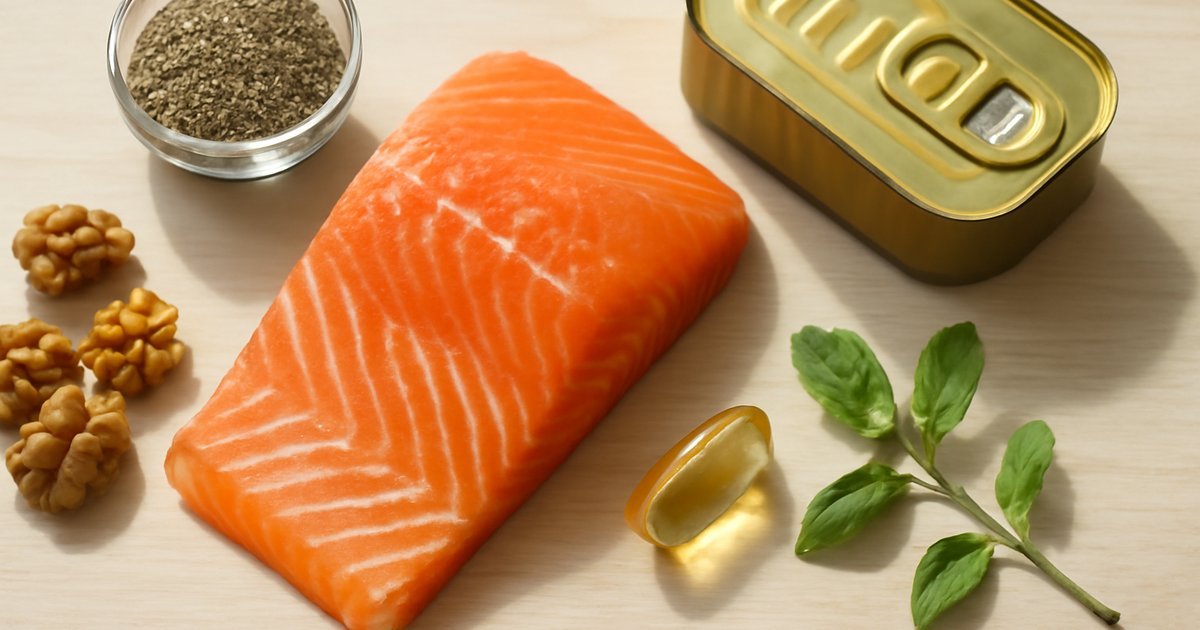
You’ve probably been told to eat more fish or take fish oil — but do you actually know why it matters, and whether you’re doing it right?
Walk into any health food store and you’ll find an entire wall dedicated to omega-3 supplements. Fish oil, krill oil, algae-based capsules — the options are overwhelming. And yet, despite all the marketing noise, most adults in the United States are still not getting enough of these essential fatty acids through their daily diets.
According to data from the National Institutes of Health (NIH), a significant portion of the U.S. population falls short of adequate omega-3 intake, particularly the two most researched forms: EPA (eicosapentaenoic acid) and DHA (docosahexaenoic acid). The gap between what people know about omega-3 and what they actually do about it is striking.
This guide cuts through the confusion. You’ll learn what omega-3 fatty acids actually do inside your body, which sources are worth your money, how to figure out the right amount for your lifestyle, and what mistakes are quietly undermining your results. Whether you’re eating the right foods or reaching for a supplement, the goal is to make this genuinely work for you — not just sit on your shelf collecting dust.
Why Omega-3 Fatty Acids Matter More Than You Think
Omega-3 fatty acids aren’t just another wellness trend. They are essential fats — meaning your body cannot produce them on its own. You have to get them from food or supplements, full stop. And when you don’t get enough, the downstream effects touch nearly every system in your body.
The most widely studied benefits center on cardiovascular health. The American Heart Association (AHA) has long recognized omega-3s as beneficial for heart health, particularly for individuals with elevated triglycerides or existing cardiovascular risk factors. Research published in the New England Journal of Medicine found that supplementation with high-dose EPA significantly reduced major cardiovascular events in people with elevated triglycerides, even when they were already taking statins.
But the heart is just the beginning. Omega-3s play a critical structural role in the brain — DHA alone makes up about 30% of the fatty acids in the brain’s gray matter, according to Harvard Health Publishing. They’re also key players in inflammation regulation, joint health, eye function, and even mood stability.
For busy adults in their 30s, 40s, and 50s, getting adequate omega-3s can quietly support energy, mental clarity, and long-term resilience — without requiring a dramatic lifestyle overhaul. That’s the kind of simple, foundational habit that tends to compound over time.
The Science Behind How Omega-3s Actually Work
Here’s where things get interesting — and where most wellness articles miss the nuance. Not all omega-3s are created equal. There are three main types you need to know: ALA, EPA, and DHA.
ALA (alpha-linolenic acid) is found mostly in plant foods like flaxseed, chia seeds, and walnuts. It’s technically an omega-3, but your body can only convert a small percentage of it into the more active EPA and DHA — typically less than 10%, according to the NIH. So while ALA has its value, relying on it alone won’t give you the full spectrum of benefits most studies are measuring.
EPA and DHA are found primarily in fatty fish, seafood, and algae. These are the forms that directly influence inflammation pathways, brain cell membranes, and cardiovascular markers. When researchers talk about omega-3 benefits in clinical studies, they’re almost always measuring EPA and DHA specifically.
One common myth worth busting: "I eat a healthy diet, so I don’t need to worry about omega-3s." Unless that healthy diet regularly includes fatty fish like salmon, mackerel, sardines, or anchovies, there’s a good chance your EPA and DHA intake is lower than optimal. A 2021 analysis published in the journal Nutrients found that average EPA and DHA consumption among U.S. adults remains well below the commonly recommended 250–500 mg per day for general health maintenance.
The mechanism is worth understanding too. Omega-3s compete with omega-6 fatty acids for the same metabolic pathways. The modern American diet tends to be heavily skewed toward omega-6s (found in vegetable oils, processed snacks, and fast food), which can promote inflammatory signaling when the balance tips too far. Increasing omega-3 intake helps recalibrate that ratio — not by eliminating omega-6s, but by giving your body the counterbalance it needs.
How to Start Getting More Omega-3s: Practical Steps
The good news: you don’t need to make dramatic changes to meaningfully increase your omega-3 intake. Here’s a practical roadmap based on where you’re starting from.
Beginner Level — Food First:
- Aim for two servings of fatty fish per week. A 3.5-ounce serving of Atlantic salmon provides roughly 2,000–2,500 mg of combined EPA and DHA — covering multiple days of needs in one meal.
- Add ground flaxseed or chia seeds to smoothies, oatmeal, or yogurt. These won’t replace EPA/DHA, but they do contribute ALA and come with fiber and other benefits.
- Swap out refined oils for olive oil in cooking, and try snacking on walnuts instead of processed crackers.
Intermediate Level — Adding a Supplement:
- If you don’t eat fish regularly (due to preference, cost, or dietary restrictions), a standard fish oil or algae-based omega-3 supplement offering 500–1,000 mg of combined EPA and DHA per day is a reasonable starting point for general health.
- Look for supplements that have been third-party tested (NSF International, USP, or IFOS certification) to verify purity and actual EPA/DHA content.
- Algae-based omega-3 supplements are a well-validated option for vegetarians and vegans — they deliver DHA and EPA directly, bypassing the low-conversion issue of plant-based ALA.
Advanced Level — Targeted Intake:
- For individuals with elevated triglycerides, specific cardiovascular risk, or joint inflammation concerns, higher doses (2,000–4,000 mg EPA/DHA per day) are sometimes used clinically — but this range warrants guidance from a physician or registered dietitian, as high doses can have blood-thinning effects.
- Consider tracking your intake for two weeks using a free food diary app to get a realistic baseline before deciding on supplementation.
Common Mistakes That Quietly Undermine Your Omega-3 Results
Even people who are genuinely trying to optimize their omega-3 intake often make avoidable errors. Here are the most common ones:
Mistake 1: Relying solely on flaxseed or chia seeds as your omega-3 source.
These are great foods with real health value, but as noted above, the conversion of ALA to active EPA and DHA is highly inefficient. If your goal is brain support, heart health, or anti-inflammatory effects, you need a direct source of EPA and DHA — from fish, seafood, or algae-based supplements.
Mistake 2: Buying a low-quality supplement and assuming all fish oil is the same.
The omega-3 supplement market is notoriously inconsistent. A 2022 review found that many commercially available fish oil products contain significantly less EPA and DHA than their labels claim — and some show signs of oxidation, which may reduce their effectiveness. Always check for third-party certification and look at the actual EPA/DHA content on the label, not just the "fish oil" total.
Mistake 3: Taking your omega-3 supplement on an empty stomach.
Fish oil capsules taken without food are a common cause of the dreaded "fish burp" — and they’re also absorbed less efficiently. Take omega-3 supplements with a meal that contains some fat to improve absorption and reduce GI discomfort. This one simple fix makes a noticeable difference for most people.
Mistake 4: Ignoring the omega-6 to omega-3 ratio in your overall diet.
Adding omega-3s while continuing to eat a diet high in refined vegetable oils and ultra-processed food is like trying to bail water out of a leaky boat. A meaningful improvement in omega-3 status often requires some reduction in omega-6-heavy oils like corn, soybean, and sunflower oil — alongside increasing omega-3 intake.
The Best Food Sources of Omega-3 Fatty Acids
The Academy of Nutrition and Dietetics recommends prioritizing whole food sources of omega-3s when possible, with supplementation used to fill genuine gaps. Here’s where to focus your attention:
Top EPA and DHA sources (per 3.5 oz / 100g serving):
- Mackerel: ~5,000 mg — one of the highest natural sources available
- Atlantic salmon (wild-caught): ~2,200 mg — widely accessible and versatile
- Sardines (canned in water): ~1,500 mg — affordable, shelf-stable, and underrated
- Anchovies: ~2,000 mg — small but nutrient-dense, great in sauces and dressings
- Rainbow trout: ~1,000 mg — a milder option that’s widely available
- Oysters: ~500 mg — bonus: they’re also rich in zinc and vitamin B12
Top ALA sources (plant-based, per tablespoon or ounce):
- Ground flaxseed (1 tbsp): ~1,600 mg ALA
- Chia seeds (1 oz): ~5,000 mg ALA
- Walnuts (1 oz): ~2,500 mg ALA
- Hemp seeds (1 tbsp): ~1,000 mg ALA
A note on farmed vs. wild-caught fish: while wild-caught varieties tend to have slightly higher omega-3 content and a better omega-6 to omega-3 ratio, the difference is modest for most people. Eating farmed salmon twice a week still delivers meaningful EPA and DHA — don’t let perfect be the enemy of good here.
For practical meal ideas, pairing any of the fatty fish options above with vegetables sautéed in olive oil, alongside a side of leafy greens, creates a genuinely anti-inflammatory meal without requiring any exotic ingredients. If you’re looking to pair this habit with other anti-inflammatory lifestyle strategies, the piece on the connection between chronic stress and inflammation is worth reading alongside this one.
How Long Until You Notice a Difference — and What to Track
One of the most realistic things you can hear about omega-3 supplementation: results are often gradual and internal. You won’t feel an omega-3 "kick" the next morning the way you might with caffeine. But that doesn’t mean nothing is happening.
According to research from the journal PLEFA (Prostaglandins, Leukotrienes and Essential Fatty Acids), meaningful changes in blood omega-3 index — a measure of EPA and DHA as a percentage of red blood cell fatty acids — typically occur within 4 to 8 weeks of consistent supplementation or dietary change. The recommended omega-3 index for cardiovascular risk reduction is above 8%, while most Americans sit around 4–5%.
What to track and notice over 4–12 weeks:
- Subjective changes in joint stiffness or morning soreness, particularly if you exercise regularly
- Mood stability and general sense of mental clarity — DHA’s role in brain membrane function can have subtle effects on cognitive ease over time
- Triglyceride levels, if your doctor monitors them during routine bloodwork — omega-3s are one of the most consistently effective dietary tools for lowering elevated triglycerides
- Skin hydration and appearance — omega-3s support the skin’s lipid barrier, and some people notice improvements in dryness or texture within 6–8 weeks
If you’re managing a cardiovascular condition, working with a physician to test your omega-3 index before and after 3–6 months of intervention gives you objective data. For most healthy adults, consistency is the most important variable — two to four servings of fatty fish per week, or a quality supplement taken daily with meals, is the practical target.
If you’re also working on overall cellular health and energy, consider reading about mitochondrial health — omega-3s and mitochondrial function are closely interrelated in the research on healthy aging.
Frequently Asked Questions
Is it better to get omega-3s from food or supplements?
Whole food sources are generally preferred because they come packaged with other nutrients — protein, vitamins, minerals — that supplements can’t replicate. That said, if you genuinely don’t eat fish, a high-quality algae-based or fish oil supplement is a well-supported alternative. The Academy of Nutrition and Dietetics recognizes both as valid approaches depending on individual circumstances.
Can you take too much omega-3?
Yes, though it takes fairly high doses. The FDA considers up to 3,000 mg of EPA and DHA per day from supplements to be generally safe for most adults, with caution advised above 5,000 mg due to potential blood-thinning effects and the risk of bleeding complications. At typical doses (500–1,000 mg/day), side effects are minimal and usually limited to GI discomfort if taken on an empty stomach.
Are omega-3s useful for mental health?
Research suggests a modest benefit for mood and depression symptoms, particularly with higher EPA content. A meta-analysis published in JAMA Network Open found that omega-3 supplementation was associated with improved depressive symptoms in adults. This is an area of active research and the effect sizes vary, but the risk-to-benefit ratio for most adults is favorable. This doesn’t replace clinical mental health treatment, but it can be a meaningful supportive habit.
What about mercury and contaminants in fish?
This is a legitimate concern for certain populations, particularly pregnant women and young children. The FDA advises those groups to limit high-mercury fish (like swordfish, tilefish, and king mackerel) while encouraging low-mercury choices like salmon, sardines, and trout. For most healthy adults eating two servings of fatty fish per week, the benefits significantly outweigh the mercury exposure risk. Quality fish oil supplements are typically purified to remove mercury and PCBs — look for IFOS-certified products for verified safety.
Do omega-3s help with weight management?
Evidence here is mixed. Omega-3s don’t directly cause fat loss, but research from the Journal of Nutritional Biochemistry suggests they may support insulin sensitivity and lean muscle preservation when combined with exercise and a balanced diet. They’re not a weight loss intervention on their own, but they fit well within a broader healthy lifestyle strategy. For foundational approaches to weight management, pairing omega-3 intake with sustainable dietary habits — like those explored in the guide to intermittent fasting — may offer complementary benefits.
The Bottom Line on Omega-3 Fatty Acids
Omega-3 fatty acids aren’t a miracle supplement — and they don’t need to be. What they are is one of the most consistently supported dietary interventions in modern health research, with benefits that range from cardiovascular and brain health to inflammation management and mood stability.
You don’t need a complicated plan. Start with two servings of fatty fish per week. Add a quality supplement if needed. Take it with food. Be consistent for at least eight weeks before evaluating how it’s working for you.
The goal isn’t perfection — it’s building a reliable baseline of nutrients your body genuinely needs. Small, consistent actions compound into meaningful health outcomes over months and years. Omega-3s, done simply and consistently, are one of the most rewarding places to start.
This article is for informational and educational purposes only. The content is not intended to replace professional medical, nutritional, or fitness advice. Always consult a qualified healthcare provider, registered dietitian, or certified fitness professional before starting a new health program or making significant changes to your lifestyle.
Content reviewed by our wellness editorial team, with references to peer-reviewed research and guidelines from leading health organizations.