You eat well, you exercise, you drink your water — yet bloating, gas, and that uncomfortable heavy feeling after meals still show up uninvited. Sound familiar?
Millions of American adults deal with digestive discomfort every single day, and a growing number are turning to digestive enzyme supplements as a potential solution. But here’s the honest truth: most people don’t fully understand what digestive enzymes actually are, what they do, and whether taking them in supplement form makes any real difference.
This isn’t another vague wellness article that tells you to “support your gut.” This is a practical, science-backed breakdown of digestive enzymes — how they work, who genuinely benefits from them, what the research says, and how to figure out if they’re worth adding to your routine.
Whether you’re dealing with post-meal bloat, trying to optimize your gut health, or just curious about the supplement aisle buzz, this guide gives you what you actually need to make an informed decision.
Why Digestive Enzymes Matter More Than You Think
Your digestive system does something remarkable every time you eat: it breaks down complex food into microscopic nutrients your cells can actually use. Proteins become amino acids. Carbohydrates become simple sugars. Fats become fatty acids. None of this happens automatically — it requires a precise chemical process driven largely by digestive enzymes.
These enzymes are proteins produced mainly by the pancreas, small intestine, and salivary glands. Without them, even the healthiest meal on the planet would pass through your body largely undigested and unused.
According to the National Institute of Diabetes and Digestive and Kidney Diseases (NIDDK), digestive enzyme insufficiency is more common than many people realize — and it’s not just a problem for people with diagnosed conditions. Natural enzyme production can decline with age, shift with chronic stress, and be impaired by various health conditions and medications.
Research published in the journal Gut has shown that even subclinical reductions in enzyme activity — meaning levels that aren’t low enough for a formal diagnosis — can contribute to symptoms like bloating, gas, loose stools, and nutrient malabsorption. These are symptoms millions of people are chalking up to “just how I am” when there may be a more specific underlying reason.
The connection between digestive enzyme function and overall gut health is also significant. A compromised enzyme environment can alter the gut microbiome by changing which nutrients reach the large intestine — and that, in turn, affects everything from immune function to mood. If you’ve read our guide on dietary fiber and gut health, you already know how tightly interconnected these systems are.
How Digestive Enzymes Actually Work
Let’s clear up one of the biggest misconceptions right away: digestive enzymes are not the same as probiotics. Probiotics are live bacteria that support your gut microbiome. Digestive enzymes are proteins that catalyze chemical reactions to break down food. They work in completely different ways, at different stages of digestion.
Here’s a quick breakdown of the main players:
- Amylase — Produced in saliva and the pancreas; breaks down carbohydrates and starches into sugars
- Lipase — Produced mainly by the pancreas; breaks down dietary fats into fatty acids and glycerol
- Protease (also called proteolytic enzymes) — Produced by the pancreas and stomach; breaks down proteins into amino acids
- Lactase — Produced in the small intestine; breaks down lactose (the sugar in dairy)
- Cellulase — Breaks down plant cellulose; humans don’t produce this naturally, which is why gut bacteria play a role in processing plant fiber
- Alpha-galactosidase — Helps break down oligosaccharides found in beans and cruciferous vegetables — the main culprits behind gas and bloating after those foods
A common myth is that you can significantly “train” your body to produce more enzymes by eating certain foods. While raw foods do contain trace enzymes, the evidence that they meaningfully supplement your body’s own enzyme output is weak. Cooking does reduce enzyme content in food, but your body compensates through its own production — in healthy individuals.
A 2022 review in Nutrients found that in individuals with verified enzyme insufficiency, targeted supplementation significantly improved nutrient absorption and reduced GI symptoms. The key phrase there is “verified insufficiency” — results vary considerably depending on baseline enzyme function.
Who Actually Benefits From Digestive Enzyme Supplements
This is where practical guidance gets important — because not everyone needs to supplement, and buying a broad-spectrum enzyme product doesn’t guarantee relief.
You may genuinely benefit from digestive enzyme support if:
- You have a diagnosed condition that impairs enzyme production — This includes exocrine pancreatic insufficiency (EPI), Crohn’s disease, cystic fibrosis, or chronic pancreatitis. People with these conditions often require prescription enzyme replacement therapy (PERT), not just OTC supplements.
- You’re lactose intolerant — This is one of the clearest, most well-researched use cases. Supplementing with lactase before consuming dairy has strong clinical support. The Academy of Nutrition and Dietetics acknowledges lactase supplements as an effective tool for managing lactose intolerance symptoms.
- You experience consistent bloating and gas after eating beans, lentils, or cruciferous vegetables — Alpha-galactosidase (the enzyme in products like Beano) has solid evidence behind it. A clinical trial published in the journal Digestive Diseases and Sciences confirmed it reduces gas production after legume consumption.
- You’re over 50 — Research suggests that pancreatic enzyme output tends to decline with age, which may contribute to subtle but cumulative malabsorption over time. Harvard Health Publishing has noted that digestive efficiency generally decreases as we age.
- You’ve recently had GI surgery or a serious illness — Any procedure or condition affecting the pancreas, gallbladder, or small intestine can significantly alter enzyme availability.
Where enzyme supplements are less likely to help:
If your digestion is otherwise healthy and your discomfort is primarily driven by stress, food sensitivities, gut dysbiosis, or an overly processed diet, enzyme supplements are unlikely to solve the root problem. They work on what’s already entering your gut — not on why your gut is reactive in the first place.
Common Mistakes That Sabotage Results
Even people who genuinely need enzyme support often don’t get results because of how they’re using the supplements. These mistakes are extremely common and easy to make.
Mistake 1: Taking enzymes at the wrong time. Digestive enzymes need to be present in your stomach when food arrives. Taking them 30 minutes before a meal or an hour after means they’re not there when they’re needed. The correct timing is right before or at the very start of your meal — always with food, never on an empty stomach.
Mistake 2: Choosing a product without matching it to your actual symptoms. Broad-spectrum enzyme blends sound impressive, but if your main issue is lactose intolerance, you need lactase specifically. If beans are your problem, you need alpha-galactosidase. Matching the enzyme to the substrate (the food causing the issue) is fundamental. Using a mismatched product often leads people to conclude that “enzymes don’t work” when the product just wasn’t right for their situation.
Mistake 3: Expecting enzymes to compensate for a poor diet. If your diet is high in ultra-processed foods, low in fiber, and inconsistent, enzymes won’t fix the underlying disruption to your gut environment. They are a tool, not a solution. Pair any enzyme support with a genuinely gut-supportive diet — more on that below.
Mistake 4: Ignoring potential interactions with medications. Certain enzyme supplements, particularly bromelain (from pineapple) and papain (from papaya), can interact with blood thinners. If you’re on any medication, check with your healthcare provider before adding digestive enzymes to your routine.
Mistake 5: Skipping the conversation with your doctor. Persistent digestive symptoms aren’t just uncomfortable — they can be signals of conditions that deserve proper evaluation. Starting supplements before ruling out celiac disease, SIBO (small intestinal bacterial overgrowth), or other treatable conditions is a mistake that can delay real solutions.
Foods That Support Natural Enzyme Production
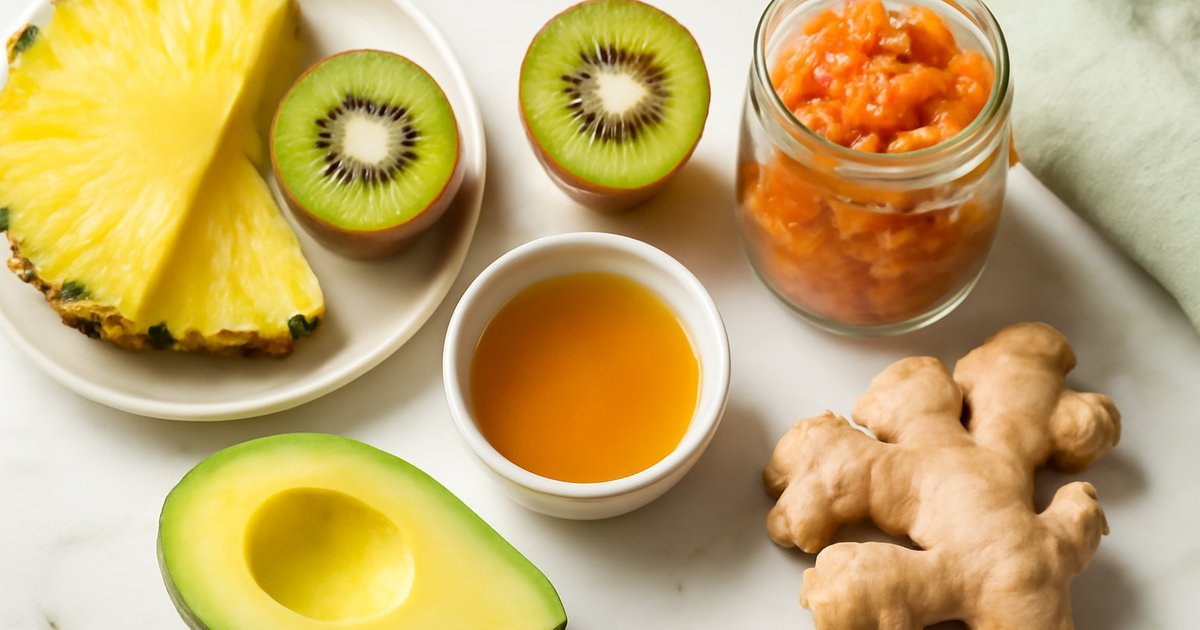
Before reaching for a supplement, it’s worth knowing that several whole foods contain naturally occurring enzymes that can support digestion — and the evidence here is actually reasonable, particularly when these foods are consumed raw or minimally processed.
Top food sources of digestive enzymes:
- Pineapple — Contains bromelain, a protease that helps break down protein. Most effective when eaten fresh, not canned (heat destroys bromelain). A serving of about ½ cup of fresh pineapple provides a meaningful amount.
- Papaya — Contains papain, another powerful protease. Raw papaya is significantly more potent than ripe, and supplements derived from it are among the more researched options.
- Kiwifruit — Contains actinidin, a cysteine protease shown in research published in Advances in Food and Nutrition Research to improve protein digestion, particularly for red meat and dairy.
- Raw honey — Contains amylase and protease, though quantities vary widely. More useful as a general whole-food choice than a therapeutic enzyme source.
- Fermented foods — Kimchi, sauerkraut, miso, and kefir contain active cultures that produce enzymes as a byproduct of fermentation. These also support the gut microbiome simultaneously — a two-for-one benefit that’s well-supported by the research community.
- Avocado — Contains lipase, which aids in fat digestion. The USDA Dietary Guidelines already recommend avocados as a healthy fat source, and their enzyme content is a bonus.
- Ginger — Contains zingibain, a protease. Research from the Journal of Ethnopharmacology has noted ginger’s role in stimulating digestive enzyme activity more broadly.
Incorporating 2–3 of these foods regularly — especially pairing them with heavier meals — can make a noticeable difference for people with mild enzyme-related discomfort, without the cost or complexity of supplementation.
How Long Until You Notice a Difference
If you’re addressing a specific, well-matched enzyme deficiency — like using lactase for lactose intolerance — results can be nearly immediate, within the same meal or the next day. That’s one of the clearest indicators that you’ve found the right solution.
For broader digestive improvement through dietary changes and general enzyme support, realistic timelines look more like this:
- 2–4 weeks: Reduction in post-meal bloating and gas frequency, especially if dietary changes are made simultaneously
- 4–8 weeks: Improvements in bowel regularity and reduced heaviness after meals
- 8–12 weeks: Potential improvements in energy levels and general well-being, if malabsorption was a contributing factor
Track these specific signals: bloating frequency and severity (use a simple 1–10 scale in a notes app), bathroom regularity, post-meal energy, and any changes in skin clarity — since gut health and skin health are more connected than most people realize.
If you’ve made dietary improvements, are consistent with a targeted supplement for 4–6 weeks, and still have significant symptoms, that’s your signal to consult a gastroenterologist. Persistent symptoms deserve proper workup — stool enzyme testing and a full GI evaluation can identify what’s actually going on. Also, if stress is a major factor in your life, know that chronic stress suppresses digestive function significantly, as we covered in our dietary fiber and gut health guide. Managing your nervous system is part of managing your gut.
Frequently Asked Questions
Are digestive enzyme supplements safe for long-term use?
For most healthy adults, OTC digestive enzyme supplements are considered safe for regular use. However, high-dose or long-term use of certain enzymes — particularly proteases — hasn’t been extensively studied in healthy populations. If you’re using them daily for more than a few months, it’s worth checking in with your healthcare provider to make sure you’re addressing root causes rather than managing symptoms indefinitely.
Can I take digestive enzymes if I have IBS?
This depends on your IBS subtype and triggers. Some people with IBS-D (diarrhea-predominant) or IBS-C (constipation-predominant) do report relief from specific enzyme combinations, but the research is still limited. A registered dietitian who specializes in GI health can help you identify whether enzyme support makes sense for your specific pattern.
Is there a difference between plant-based and animal-derived enzyme supplements?
Yes. Animal-derived enzymes (like pancreatin, derived from porcine or bovine pancreas) tend to be more potent and are often used in prescription formulas for serious conditions. Plant-based enzymes — derived from fungi, papaya, pineapple, and similar sources — are milder and more appropriate for general digestive support. If you follow a plant-based diet, look specifically for vegan-certified enzyme products.
Do digestive enzymes help with weight management?
Indirectly, possibly. If enzyme insufficiency is causing malabsorption, improved digestion might help your body more efficiently use the nutrients from food — which can support energy, reduce cravings driven by nutrient gaps, and improve satiety. However, digestive enzymes are not a weight loss tool on their own, and any claims suggesting they directly cause fat loss are not supported by strong clinical evidence.
What’s the difference between digestive enzymes and stomach acid?
They work together but aren’t the same thing. Stomach acid (hydrochloric acid) creates the acidic environment needed to activate certain enzymes and kill pathogens. Digestive enzymes do the actual chemical work of breaking down food molecules. Low stomach acid (hypochlorhydria) can actually impair enzyme function — so if you’ve been taking antacids long-term, that’s worth discussing with your doctor.
The Bottom Line on Digestive Enzymes
Digestive enzymes are not magic pills — but for the right person with the right match, they can be genuinely helpful tools for improving comfort, nutrient absorption, and overall gut function. The science is clearest for specific enzyme deficiencies: lactase for lactose intolerance, alpha-galactosidase for bean-related bloating, and pancreatic enzymes for diagnosed insufficiency.
If you’re dealing with general bloating and discomfort, start with what you eat before jumping to supplements. Add pineapple, kiwi, fermented foods, and ginger to your regular rotation. Cut back on ultra-processed foods. Eat slowly and chew thoroughly — that’s not just old advice, it actually activates salivary amylase and signals the rest of your digestive cascade.
Small, consistent actions compound over time. Your gut doesn’t need a dramatic overhaul — it needs steady, thoughtful support. Take one step today: pick one enzyme-rich food to add to your next meal, and pay attention to how you feel afterward. That simple experiment might tell you more than you expect.
Wellness Disclaimer: This article is for informational and educational purposes only. The content is not intended to replace professional medical, nutritional, or fitness advice. Always consult a qualified healthcare provider, registered dietitian, or certified fitness professional before starting a new health program or making significant changes to your lifestyle.
Content reviewed by our wellness editorial team, with references to peer-reviewed research and guidelines from leading health organizations.